

Highlands Pacific Limited (HIG)
Open Briefing MD on Ramu Production and Outlook
03 May 2012 - MD: John Gooding
In this Open Briefing®, MD John Gooding discusses:
- Ramu Nickel Cobalt Mine commissioning progress
- Wet laterite vs dry laterite processing
- Project cash flow potential
openbriefing.com
Highlands Pacific Limited (ASX: HIG) recently reported that the Ramu Nickel Cobalt Mine (HIG 8.56%, with ability to go to 20.55%) has begun early stage commissioning, with a successful six week operational test of the first of three high pressure acid leach autoclaves. To what extent has plant performance met expectations?
MD John Gooding
The operator and Highlands have been very satisfied with the performance of the mine and the plant to date. We’ve shut down the first autoclave after its successful test operation, and we’ve now begun testing the second autoclave (or train). The tests are providing the operators with important information that will enable the process to be optimised. The final autoclave will be commissioned during the September quarter.
openbriefing.com
What is the commissioning schedule for the autoclaves?
MD John Gooding
The aim is to have commissioned or tested all three autoclaves by the end of September. Last week the first autoclave was shut down for inspection and maintenance and commissioning began on a second autoclave circuit. The second train will run for four to six weeks before it is shut down. At some stage, during the June quarter, we expect the two trains will be running together with the third and final train load commissioned in the September quarter. This is all part of a careful and staged process.
openbriefing.com
When do you expect to reach nameplate output of 31,150 tonnes nickel and 3,300 tonnes cobalt per annum?
MD John Gooding
As we’ve said previously, it is our expectation that the project will be running close to its name plate production by the middle of 2013. For a long life asset like Ramu that we want to see operating safely and efficiently for the next 20 plus years, whether we have it fully commissioned a quarter early or a quarter late is not of great concern. It’s more important that this modern project continues to make steady progress.
openbriefing.com
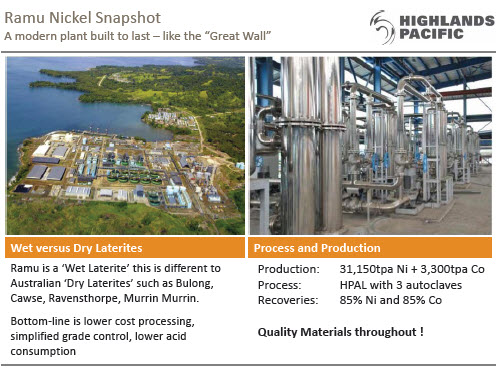
The Ramu resource is a ‘wet laterite’ ore, in contrast to the ‘dry laterites’ that are more commonplace in Australian nickel projects. How will this impact the ongoing capital and operating costs of the mine versus a dry laterite project?
MD John Gooding
Ramu as you say is a wet laterite, similar to those in The Philippines, New Caledonia and Indonesia. This means that the magnesium content is lower which assists in nickel recoveries and reduces the amount of acid used in the process, hence providing a lower operating cost environment.
In regards to the ongoing capital, the material selection in the initial plant construction is the key, and is where many of the early Western Australian dry laterite projects fell down. At Ramu, the material selection has been world class and this will assist in reducing on-going capital in comparison with those early projects. In addition, high pressure acid leach (HPAL) plants these days are close to third generation, so there have been many improvements since the first generation plants used in those Western Australia plants.
openbriefing.com
Locally, there have been environmental issues raised regarding the 135 km slurry pipeline. Are there grounds for these environmental concerns?
MD John Gooding
Rumours on the internet are hard to counter. What I can say is the pipeline has been operating for a number of months. Yes, there was a landslide at one section of the pipeline a few months ago and remedial work has been ongoing. This has had no impact on the operating performance of the pipeline or the project and represents no risk to the community. The 600 mm 135 km pipeline was designed and built to be flexible, which is required when you’re operating in a country like PNG where landslides are common.
It’s important to remember the slurry being transported in this pipeline to the process plant is basically ground up mud in a solution of water and that it carries no introduced chemicals at this early stage of the process.
openbriefing.com
Once the plant is fully commissioned and producing at full capacity, when do you expect to see cash flow from Highlands’ 8.56% interest in Ramu?
MD John Gooding
Highlands is in the enviable position of being carried, with its share of debt financing and servicing capped. The project debt servicing is paid out of the annual operating cash flows and any excess cash above this debt service is paid to Highlands. At a long term commodity price of US$9/lb for nickel we would anticipate receiving US$3 million to US$5 million per year up until 2018 by which stage the debt will have been repaid. Post this, when our equity interest moves to 11.3% and with the project free of ongoing debt repayments, Highlands’ share of free cash flow would be approximately US$15 million to US$20 million, based on the same long term commodity pricing.
openbriefing.com
Given Highlands holds a minority interest in Ramu, is it a core or non-core asset for the company?
MD John Gooding
Like all companies, all our assets are for sale at the right price. Our historical holding cost is around $100 million, and we have an important share in a very modern US$1.5 billion project where we have the ability to firstly market our share of the product and secondly, increase our percentage interest over time to 20.55%. We are content with our holding in Ramu for now and we believe it will have greater value in years to come. If or when we may seek to realise its value is an issue we will review from time to time.
openbriefing.com
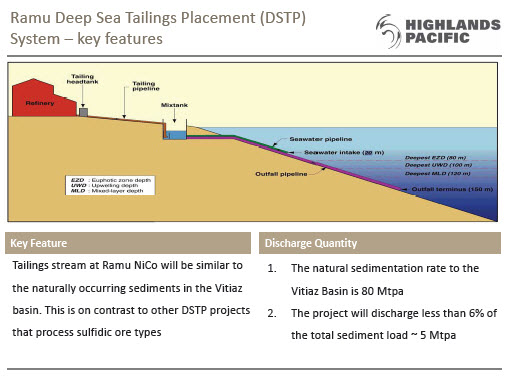
Ramu’s commissioning was delayed by two years due to legal issues relating to the project’s deep sea tailings placement (DSTP) system. What level of confidence do you have that these issues have now been resolved and that the project will be able to operate without interruption?
MD John Gooding
That delay was extremely disappointing but we are confident that it is all behind the project now. Now that the project is in operation, it will undergo statutory and operating monitoring, with an emphasis on the DSTP system, which it rightly should. I have little doubt a number of NGOs will continue to run a campaign against the DSTP and Ramu more generally but if shareholders look behind the claims and look at the science, I hope they will come to the view that the tailings, essentially ground-up mud, are well managed and pose a low environment risk.
openbriefing.com
What is the company’s involvement with stakeholders and landowners in the region?
MD John Gooding
Landowners have waited a long time for Ramu to be developed. Four main landowner groups are intimately involved in the project and have been for a long time. The media will from time to time focus on some broader political or community dissatisfaction with the pace of social and community programs but generally speaking we believe the community programs are working well. All parties recognise that without Ramu operating safely, efficiently and profitably, that royalties, jobs and social programs cannot occur.
openbriefing.com
Resource nationalism is an issue that has arisen in recent times in some mining countries around the world. What is the taxation environment in PNG for the Ramu mine?
MD John Gooding
At a project level, Ramu has a ten year tax holiday with fiscal stability clauses in place. This was agreed in 2000 as part of the mining development contract with the PNG Government. I have seen some criticism from various groups about how PNG does not have direct equity in some resource projects. In the case of Ramu, which has taken some 40 years to be developed, the PNG government at one stage held a 31.5% interest through Orogen Minerals and this ownership was ultimately sold down in bringing in a partner to develop Ramu. What people also fail to acknowledge is that through the Ramu project, US$1.5 billion of risk capital has been invested into PNG for the good of PNG and the creation of many jobs and new skills. It is unlikely that this project would have been developed without the capital and construction capability that MCC, our major partner, brought in from China.
openbriefing.com
Thank you John.
For more information on Highlands Pacific Limited, visit www.highlandspacific.com or call John Gooding or CFO Craig Lennon on +61 7 3239 7800
DISCLAIMER: Orient Capital Pty Ltd has taken all reasonable care in publishing the information contained in this Open Briefing®; furthermore, the entirety of this Open Briefing® has been approved for release to the market by the participating company. It is information given in a summary form and does not purport to be complete. The information contained is not intended to be used as the basis for making any investment decision and you are solely responsible for any use you choose to make of the information. We strongly advise that you seek independent professional advice before making any investment decisions. Orient Capital Pty Ltd is not responsible for any consequences of the use you make of the information, including any loss or damage you or a third party might suffer as a result of that use.



Latest Open Briefings 
05 Oct 2012
MD on Company Update and Outlook
27 Feb 2012
Frieda River Resource Upgrade
02 Sep 2011
MD on Frieda Resource
23 Aug 2011
CEO on Company Outlook
